Taxes, Income Tax, and Resident Tax in Japan
When you work or live in Japan, you pay various taxes.
When you work or live in Japan, you pay various taxes.
The two that people working at a company especially often encounter are:
- Income Tax
- Resident Tax
Even though both are "taxes," who you pay, when it is calculated, and how you pay all differ.
Income Tax vs. Resident Tax
Income Tax
- Paid to the national government based on that year's income
- For company employees, usually withheld from monthly salary
Resident Tax
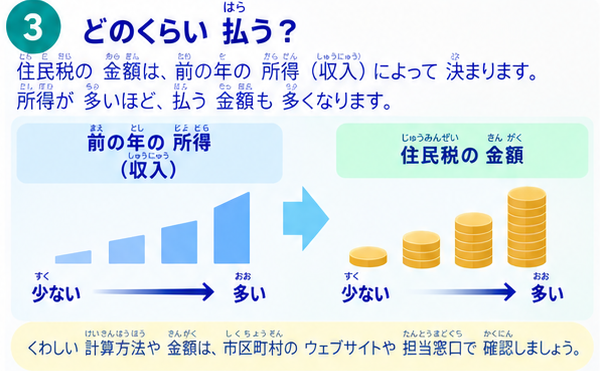
- Paid to the prefecture / municipality based on the previous year's income, among other factors
- For company employees, usually withheld from salary from June through May of the following year
What Is Income Tax?
Income Tax is a tax paid to the national government based on that year's income.
For company employees, Income Tax is usually withheld from their monthly salary.
This mechanism is called "withholding at source" (源泉徴収).
The procedure where the company recalculates, at the end of the year, the difference between the amount withheld each month and the Income Tax actually owed for that year is called "year-end adjustment" (年末調整).
For many company employees, their Income Tax procedure for the year is completed through year-end adjustment.
However, some people need to file a final tax return (確定申告).
What Is Resident Tax?
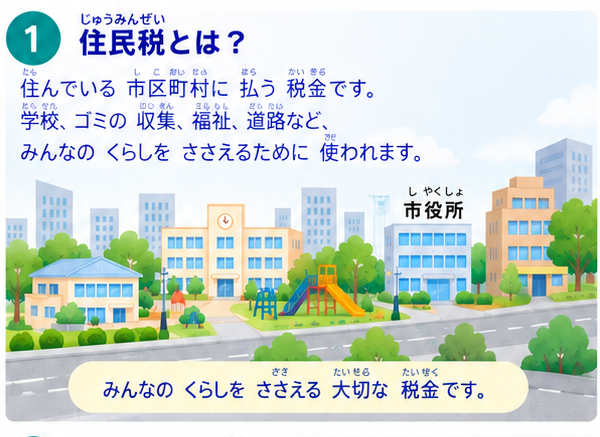
Resident Tax is a tax paid to the prefecture and the municipality (市区町村).
It is calculated based on the previous year's income, among other factors.
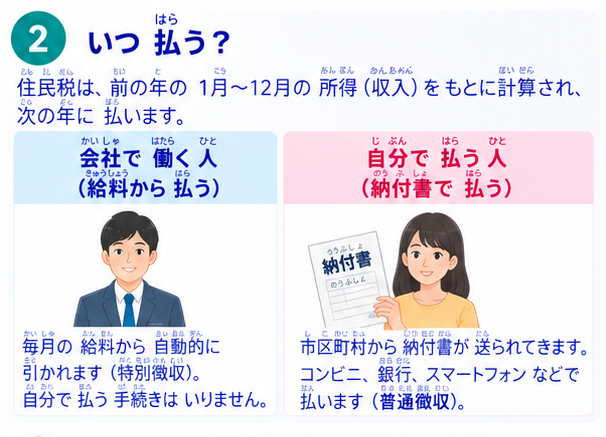
For company employees, Resident Tax is usually withheld from their monthly salary from June through May of the following year.
The method where the company withholds Resident Tax from salary and pays it is called "special collection" (特別徴収).
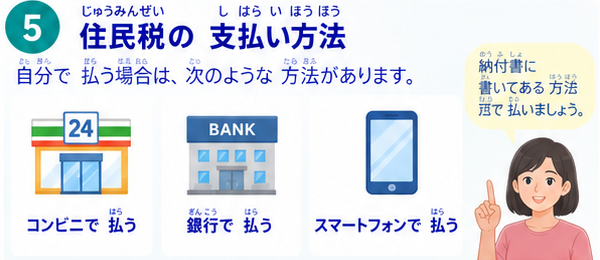
When paying it yourself, you pay using a tax payment notice, among other documents, sent from the municipality. This is called "ordinary collection" (普通徴収).
Income Tax and Resident Tax Are Paid at Different Times
Income Tax is withheld in the same year from that year's salary, among other income.
Resident Tax is, as a basic rule, paid in the following fiscal year based on the previous year's income.
Because of this, even if you leave a company and your current income decreases, you may still pay Resident Tax based on the previous year's income.
Some people are surprised when a Resident Tax payment notice arrives after they resign, so when you resign, check your method of paying Resident Tax.
Resident Tax When You Leave a Company
Even if you leave a company, the remaining Resident Tax for that fiscal year does not disappear.
How you pay the remaining Resident Tax changes depending on when you resign.
If You Resign Between June 1 and December 31
Usually, the remaining amount that can no longer be withheld from your salary changes to a method where you pay it yourself.
If you wish, in some cases you can pay the remaining amount all at once from your last salary or severance pay, among other sources.
You may also complete a procedure to continue paying through your new company's salary.
If You Resign Between January 1 and April 30
In certain cases, the remaining Resident Tax you were scheduled to pay by May is withheld all at once from your last salary or severance pay, among other sources.
If You Resign in May
Usually, the May portion of Resident Tax is withheld from that month's salary.
If you are not sure of your own payment method, check with your company or the municipality where you live.
Check your Resident Tax after resignationCheck based on when you left the company
The source's conditions 'usually,' 'in certain cases,' and 'in some cases' are preserved.
June 1 – December 31
- Usually changes to paying it yourself
- If you wish, you can pay the remaining amount all at once from your last salary, etc.
- There is also a procedure to continue paying through your new company
January 1 – April 30
- In certain cases, the remaining amount up to May is withheld all at once from your last salary or severance pay, etc.
May
- Usually, the May portion is withheld from that month's salary
Withholding Slip
The "Withholding Slip for Salary Income" (給与所得の源泉徴収票) is a document you receive from your company.
It mainly contains the following information:
- The salary paid to you by the company that year
- The Income Tax withheld from your salary
It is used for year-end adjustment at your next company, or when filing your own final tax return, among other purposes.
For people who resigned partway through the year, it is, as a general rule, issued by the company within one month of resignation.
If it does not arrive, first check with your company.
Year-End Adjustment
Year-end adjustment is the procedure where the company recalculates one year's worth of Income Tax.
Many company employees receive year-end adjustment through their company.
People who changed jobs sometimes submit their previous company's Withholding Slip to their new company.
Final Tax Return
A final tax return is the procedure where you report your own income and taxes, among other information, for one year directly to the tax office.
Even company employees may sometimes need to file a final tax return.
On the other hand, filing a final tax return can also result in a refund of overpaid tax.
If you are not sure whether it is necessary, check with the National Tax Agency's guidance or a tax office.
Foreign Nationals and Taxes
Foreign nationals may also have to pay Japanese taxes when they live or work in Japan.
However, for Income Tax, whether you are treated as a "resident" or "non-resident," among other classifications, changes depending on your period of residence in Japan and the location of your living base, and this also changes the scope of income subject to taxation.
People with income from overseas, and people leaving Japan, among others, should check with a tax office or a tax accountant.
If You Are Not Sure
- Income Tax / final tax return → Tax office, National Tax Agency
- Resident Tax → The municipality where you live
- Tax withheld from your salary → Your company's payroll/HR department
- When individual tax judgment is needed → An expert such as a tax accountant
What You Can Check Next
- Year-end adjustment and final tax return
- Leaving a job, changing jobs, or becoming unemployed
- Leaving Japan and returning to your home country
- Not sure where to consult
Main Sources to Check
- National Tax Agency
- Municipal government (shikuchoson)
- Prefecture
Last checked: August 2026