Considering or Going Through a Divorce
In an international divorce, multiple issues may be involved beyond the divorce itself — residence status, children, custody, child support, property, and housing, among others.
In an international divorce, multiple issues may be involved beyond the divorce itself — residence status, children, custody, child support, property, and housing, among others.
JANIA does not make individual legal determinations; instead, this page organizes what to check first and where to consult.
First, check your safety
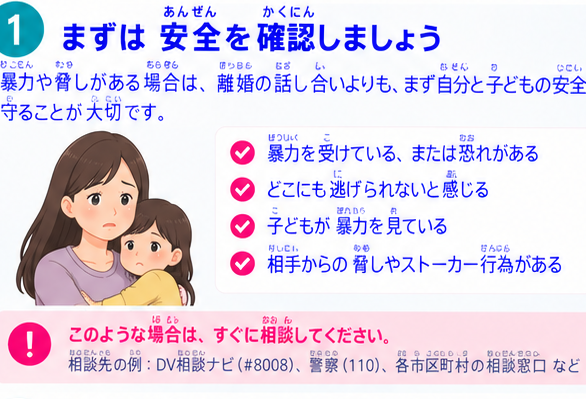
Immediate danger from DV or violence
Secure your own and your children's safety before pursuing divorce procedures. Call 110, or 119 if injured and an ambulance is needed. DV consultation counters are also availableChecking about divorce
Check separately: ways to divorce, residence status, children, money and housing, and procedures on your home country's side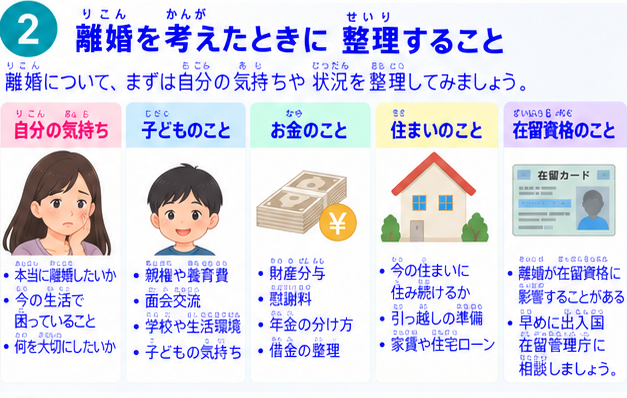
Are you safe right now?
If there is domestic violence (DV) or abuse, secure your own and your children's safety before pursuing divorce procedures.
If you are in immediate danger, call 110; if you are injured and need an ambulance, call 119.
DV consultation counters are also available.
Ways to divorce
In Japan, in addition to divorce by mutual agreement (kyogi rikon), in which both spouses agree and submit a divorce notification, there is also mediation or litigation at a family court, among other methods.
In an international marriage, specialist confirmation may be needed regarding which country's law applies, and whether a divorce in Japan will be recognized in your home country.
Residence status
People whose qualifying residence status (zairyu shikaku) is based on a spousal relationship — such as "Dependent," "Spouse or Child of a Japanese National," or "Spouse or Child of a Permanent Resident" — must notify the Immigration Services Agency of Japan in the case of divorce or bereavement.
Those who are subject to this must notify within 14 days of the date of the divorce.
If you want to continue living in Japan after the divorce, check whether your current residence status remains valid, or whether a change of residence status is needed.
Check by area
In an international divorce, multiple issues may be involved.
Ways to divorce / municipality
- Divorce by mutual agreement
- Mediation or litigation at a family court, among others
- Specialist confirmation may be needed regarding the relevant country's law and how it is treated in your home country
Residence status
- For a qualifying residence status based on a spousal relationship, those subject to it must notify within 14 days of the date of divorce
- Check your residence status after the divorce separately
Children, money, and housing
- Custody, child support, visitation, address, residence status, nationality
- Joint property, debts, housing, living expenses
Legal consultation / your home country's side
- Houterasu, lawyers, and others
- A separate notification or registration may be required in your home country even if finalized in Japan
When you have children
You will need to sort out the following:
- Custody
- Child support
- Visitation (parenting time)
- The child's address
- The child's residence status
- The child's nationality
If a legal determination is needed, please consult a lawyer or similar.
Money and housing matters
Joint property, debts, housing, living expenses, and similar can also become issues.
Do not rush to sign documents you do not understand; consult a specialist as needed.
Procedures on your home country's side
Even if a divorce is finalized in Japan, a separate notification or registration may be required in your home country.
Please check with the embassy or consulate.
What you can check next
- Domestic Violence (DV) or Afraid of Your Partner
- Renewing Your Period of Stay, and When Your Situation Changes
- Consulting a Lawyer or Houterasu
- No Money to Live On, and Public Assistance
Main places to check
- Municipalities
- Regional Immigration Services Bureau
- Houterasu
- Lawyers
- DV consultation counters
- Embassies and consulates