Year-End Tax Adjustment and Final Tax Return
When you work in Japan, "year-end tax adjustment" (nenmatsu chosei) or a "final tax return" (kakutei shinkoku) may be involved in settling or reporting your income tax.
When you work in Japan, "year-end tax adjustment" (nenmatsu chosei) or a "final tax return" (kakutei shinkoku) may be involved in settling or reporting your income tax.
Year-end tax adjustment and final tax return
Even company employees may need to file a final tax return depending on their income situation. Filing does not always result in a tax refund. If you changed jobs partway through the year, you may need to submit your previous employer's withholding tax statement to your new employer.
Year-end tax adjustment
- The company settles, at year-end, the difference between the income tax withheld over the year and the income tax actually owed
- Applies to many salaried employees who meet certain conditions
Final tax return
- You yourself may need to file, depending on conditions such as your income situation
- If you meet the conditions, overpaid tax may be refunded
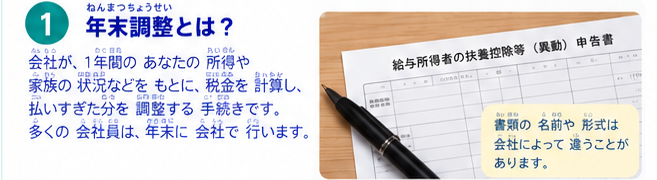
Year-end tax adjustment
For company employees and similar, income tax is deducted from your salary every month.
Year-end tax adjustment is the process where, at the end of the year, the company settles the difference between the income tax withheld over the year and the income tax you actually owe.
For many salaried employees who meet certain conditions, their income tax procedures are completed through their company's year-end tax adjustment.
If you changed jobs
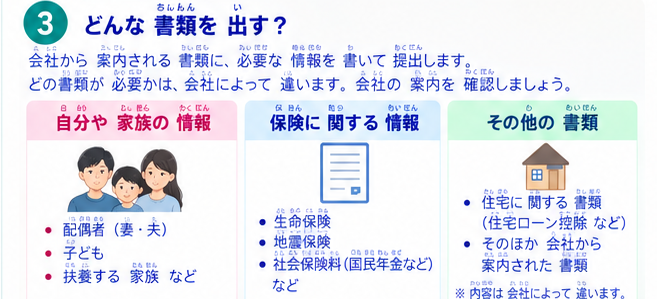
If you changed jobs partway through the year, you may submit the withholding tax statement (gensen choshuhyo) you received from your previous employer to your new employer, and have your year-end tax adjustment done including the salary from your previous employer.
Without the withholding tax statement, year-end tax adjustment may not be possible.
People who need to file a final tax return
Even company employees may need to file a final tax return, depending on their income situation and similar.
For example, this can include people whose salary income exceeds a certain amount, people with non-salary income exceeding a certain amount, and some people who receive salary from multiple employers.
The conditions are detailed, so check the National Tax Agency's guidance.
Filing a final tax return can sometimes result in a tax refund
If you meet the conditions and file a final tax return — for example, for a medical expense deduction — you may have overpaid tax refunded.
If you are leaving Japan
If you are leaving Japan, for example to return to your home country, you may need to complete tax filing procedures or procedures for a tax agent (nozei kanrinin).
Check before you leave the country.
What you can check next
- Taxes, income tax, and resident tax in Japan
- Leaving a job, changing jobs, or becoming unemployed
- Leaving Japan and returning to your home country
Main places to check
- National Tax Agency
- Tax office
Last checked: August 2026