Japan's School System, and Enrolling in Elementary or Junior High School
Japanese schools are mainly divided as follows:
Japanese schools are mainly divided as follows:
- Elementary school: 6 years
- Junior high school: 3 years
- High school: 3 years
- University, and others
In Japan, Japanese children have 9 years of compulsory education across elementary and junior high school.
Parents of children with foreign nationality are not under a legal obligation to send their children to a Japanese school, but if they wish, their children can attend public elementary and junior high schools free of charge, in the same way as Japanese children.
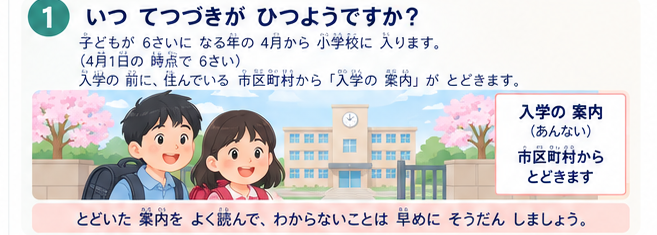
If you want to enroll your child in a public elementary or junior high school
Consult the board of education or government office of the city, town, or ward you live in.
Things that will be checked include:
- Your child's age
- Whether they are currently attending a school
- Your address
- Whether Japanese language learning support is needed
and similar.
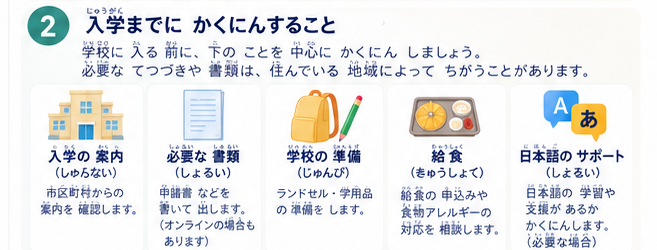
Procedures for enrolling in school
For children with foreign nationality, the city, town, or ward may send an enrollment guide.
Even if you don't receive one, or if your child came to Japan partway through, consult the board of education.
The procedures and documents needed for enrollment or transferring schools differ depending on the municipality and the situation.
Enrolling in elementary and junior high school
Japanese children
- 9 years of compulsory education across elementary and junior high school
Children with foreign nationality
- Parents are not under a legal obligation to send their children to a Japanese school
- If they wish, their children can attend public elementary and junior high schools free of charge, in the same way as Japanese children
Grade level
Japanese schools generally place children in the grade level that matches their age.
If the grade level at a school your child attended overseas differs from the Japanese grade system, consult the board of education or the school.
Costs at school
There is no tuition at public elementary and junior high schools.
However, costs such as:
- School lunch fees
- School supplies
- Costs for school events
may be necessary.
For families who find it financially difficult to pay, there are systems such as school attendance assistance (shugaku enjo).
If your child doesn't understand Japanese well yet
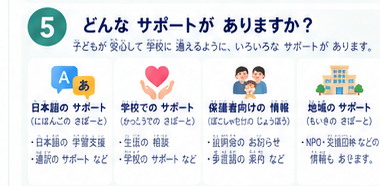
Some schools and municipalities provide Japanese language instruction and learning support for children with foreign roots.
If your child cannot speak Japanese well enough, tell the board of education or the school.
Costs at public elementary and junior high schools
Tuition
- None
Other costs
- School lunch fees
- School supplies
- Costs for school events may be necessary
About school life
Japanese schools also involve things beyond classes, such as:
- School lunch
- Cleaning
- School events
- Health checkups
- Communication with parents/guardians
If you don't understand a document sent home from school, don't leave it as is — consult the school.
If your child isn't attending school
If your child isn't attending school, doesn't want to go to school, or you're not sure where to enroll them, consult the board of education or the school's consultation counter.
What you can check next
- Japanese Language Support for Children with Foreign Roots
- High School Admission and Entrance Exams
- Learning Japanese and local Japanese classes
- Not sure where to consult
Main places to check
- Ministry of Education, Culture, Sports, Science and Technology
- Municipal board of education
- The school
Last checked: August 2026